The healing power of sleep

I would like to start by posing a question
Why is sleep important?
Put simply, sleep is a vital building block for our greater overall health. From memory, muscle repair, to improved immune systems, sleep encompasses all, and yet, it is often forgotten about or pushed aside in today's busy culture.
Remarkably, it is not uncommon for people to take pride in operating on very little sleep. Referencing sayings like “Money never sleeps” or “Sleep is a luxury”, and yet if we listen to our bodies and science, they tell us a very different story.
Sleep is needed
Sleep is productive
Sleep is essential
But don’t just take my word for it.
Sleep scientist
〰️
Author
〰️
Professor of Neuroscience and Psychology at the University of California, Berkeley
〰️
Director of the Center for Human Sleep Science
〰️
Dr. Matt Walker
〰️
Sleep scientist 〰️ Author 〰️ Professor of Neuroscience and Psychology at the University of California, Berkeley 〰️ Director of the Center for Human Sleep Science 〰️ Dr. Matt Walker 〰️
Matt Walker shares invaluable insights into the importance of sleep in multiple TED talks.
We highly recommend “Sleep is your superpower” which is linked below.
Matt Walker: Sleep is your superpower | TED Talk
I truly believe that if people prioritized their health, not only would they be healthier, but they would also be more productive. I understand some people feel like they are losing valuable time when sleeping. Yet I believe a good night's rest allows you to be more productive throughout the day, while giving your mind and body what it needs to function at a proper level.
Why sacrifice your health when you can be healthy and productive?
The two don’t need to be on opposite sides of the spectrum.
With the right outlook, they can work together hand in hand.
The question you may be asking is, “Well, how do I get a good night's sleep?”
Below, I will share with you healthy sleep habits and tips for better sleep quality.
But before we get started, I want to give you this reminder.
You may not always get a good night’s sleep. From time to time, that is OK and normal. It is important not to become anxious about getting perfect sleep. Sleep should not become a life stressor, but rather something that is healing and beneficial to your body and mind. So simply do your best to implement good sleep habits and allow yourself to have some bad days of rest. It happens to all of us. The goal instead should be fairly consistent good and or great sleep if possible.
Let's begin!
When getting a good night’s sleep, there are 3 key things I like to consider.
Quality
Quantity
Consistency
Let’s start with Quality
Several adjustments can be made to enhance the quality of a good night’s sleep.
Within Quality of Sleep, there are a few subcategories I find useful to consider as well.
Physical
Environmental
Mental/Emotional
Ok, let’s break it down.
Physical
Consider making sure you are wearing comfortable pajamas
Clothing should not be restrictive or abrasive.
Look for soft, comfortable fabrics.
Consider comfortable bedding and sheets
Invest in soft, comfortable bedding and sheets. Remember, you don’t need the highest-end materials, just something comfortable. There are many affordable options out there.
Some studies show some people can benefit from a weighted blanket, or if on a budget, layer blankets you have to create additional weight and comfort.
Regularly change out/clean bedding and sheets (Once a week)
Possibly every 3-4 days if you have
Pets that you share your bed with
Sensitive skin and or (Acne/Eczema)
Allergies / Asthma
Sweat heavily at night
Avoid eating before bed
Studies suggest you should ideally finish eating 2-3 hours before bed.
The Health Impact of Nighttime Eating: Old and New Perspectives
Avoid strenuous physical activity for at least two hours before getting into bed.
Environmental
Make sure the room temperature is at an optimal and comfortable level
Studies suggest a room temperature of around 65-68 degrees Fahrenheit or 18-20 degrees celcuis as ideal.
However, each person is different. Age and bedding system do play a factor in finding a comfortable temperature.
Make sure the environment is quiet (or at least relatively quiet)
Make sure your room is dark (Of course as dark as you feel comfortable with)
Your bed is for sleeping
Although tempting, avoid being on you phone, watching TV, working on a laptop and anything else unrelated to sleep. Your mind should associate your bed with sleep.
Wake up with a sunrise alarm clock. Although not necessary, we highly recommend them. Sunrise alarm clocks can help you wake up in a gentle and pleasant way instead of an abrupt, loud, and irritating alarm. There are affordable options, but if you are on a tight budget, I still recommend investing in a separate alarm clock.
This helps keep electronic devices out of your bedroom. (By not using your phone as an alarm, you are less likely to go on your phone right after you wake up. Which can decrease productivity, be a potential demotivator, and a negative and emotional way to start the day.)
Just as you want to avoid electronic devices when first waking up, it is widely known (although not always applied) that avoiding screens before bed helps improve the quality and possibly the quantity of sleep too. Ideally, no screens an hour before bed.
I do understand it can be difficult, but it is well worth it and becomes easier over time.
If needed, work on this through small steps.
Like many improvements, building on smaller steps is often a great way to continue to make progress. (especially for something that is difficult)
Example: Start by focusing on - no screens 15 minutes before bed
Then 30 minutes before bed and so on until you reach 1 hour consistently.
Of course adjust each step to meet your ability, but don’t forget to push yourself outside your comfort zone a little bit.
Reducing device brightness at night
Utilize features like “reduce white point” on IOS and “extra dim” on Andriod to further decrease brightness if you are using your phone before bed (But hopefully not)
To better understand how your environment impacts sleep. View
Mental/Emotional
Create a habit stack/ routine before bed and when you wake up in the morning (habits can be beneficial as they take less brain power and are done in a more automated way. This can also help keep nighttime and morning routines efficient and off of electronic devices (To better understand habit stacking and routines, we highly recommend “Atomic Habits” by James Clear)
NO short content before bed or when you first wake up (Short content is terrible for your mind regardless of the time of day. But at the bare minimum, you should not be consuming it before bed or when you first wake up. People I have spoken to as well as myself have noticed over time
Less Racing thoughts, less frustration, and less angry and sad emotions, and overall just more calm.
To help with overthinking/circling thoughts, and restlessness, especially before bed
Try Journaling
Praying
Devotional Books
Meditation
A study of Improved sleep through mindfulness
Next is Quantity
Consider how much sleep you need, especially for your age and level of activity.
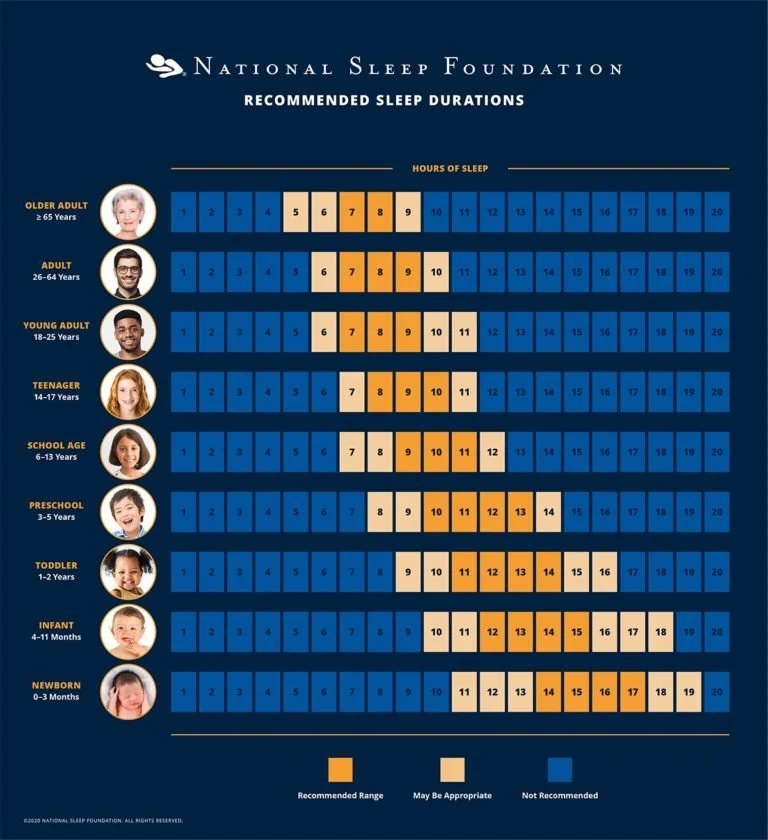
How Much Sleep Do You Really Need? - National Sleep Foundation
Also, consider if you are receiving enough, high-quality sleep. Ideally, you shouldn't rely on caffeine to boost your energy. I personally believe regularly consuming caffeine, whether through coffee, energy drinks, etc. for the sake of increasing energy or “making it through the day” is an indication you are not getting enough high-quality sleep, and that is unhealthy.
Coffee, energy drinks, etc are not a solution, rather a bandage to a larger problem and need for sleep that your mind and body require to be healthy.
Last but not least…Consistency
Try to get to bed and wake up at similar times every day (This includes weekends)
This is to help keep your Circadian rhythm in check (Also known as your internal clock)
It is ideal to have no more than an hour variance between your baseline target. For example, if you go to bed at 10:30 pm, you should go to bed around the same time even on weekends and by the latest 11:30 pm.
Having or finding a “why” to get up really makes a big difference.
When you have something you look forward to doing during the day or you have a reason for getting up (including future goals), it makes it a lot easier to get out of bed and get ready to tackle the day.
Creating habits for when you wake up. This way, you are using less mental effort to get ready for the day. This can help get you set up for the day.
Consider habit stacking
Also, having a reason and a “why” helps as a motivation to go to bed on time because you want to work towards something and you want to achieve something. So you want to be on your A-Game, which gives you a reason to go to bed on time.
If you’ve made it this far. I want you to know I’m routing for you and wish you the best on your journey to peace. If you have any feedback on how we can improve Kynr please let us know. Whether that's through the comments section below, a personal email, feel free to email us at connect@kynr.co, or simply go to the “contact us” tab on our website and message us that way.
Love,
Kynr
Work Cited
Walker, Matt. “Sleep is your superpower” Ted Talk, April. 2019,
https://www.ted.com/talks/matt_walker_sleep_is_your_superpower
“Is Eating Before Bed Bad for You?” Cleveland Clinic, 23, March. 2022,
https://health.clevelandclinic.org/is-eating-before-bed-bad-for-you
Kinsey, Amber. and Ormsbee, Michael. “The Health Impact of Nighttime Eating: Old and New Perspectives” MDPI, 9, April. 2015,
https://www.mdpi.com/2072-6643/7/4/2648
LeWine, Howard. “Does exercising at night affect sleep?” Harvard Health Publishing Harvard Medical School, 24, July. 2024,
https://www.health.harvard.edu/staying-healthy/does-exercising-at-night-affect-sleep
Caddick, Zachary. Gregory, Kevin. Arsintescu, Lucia. Flynn-Evans, Erin. “A review of the environmental parameters necessary for an optimal sleep environment” ScienceDirect, 9, March. 2018, https://www.sciencedirect.com/science/article/abs/pii/S0360132318300325
Jiang, AnHang. Li, Shuang. Wang, HuaBin. Ni, HaoSen. Chen, HongAn. Dai, JunHong.
Xu, XueFeng. Li, Mei. Dong, Guang-Heng. “Assessing Short-Video Dependence for e-Mental Health: Development and Validation Study of the Short-Video Dependence Scale” ScienceDirect, 6, March. 2025, https://www.sciencedirect.com/org/science/article/pii/S1438887125003061
Zhang, Xing. Wu, You. Liu, Shan. “Exploring short-form video application addiction: Socio-technical and attachment perspectives” ScienceDirect, 9, July. 2019,
https://www.sciencedirect.com/science/article/abs/pii/S0736585319303302
Qin, Yao. Omar, Bahiyah. Musetti, Alessandro. “The addiction behavior of short-form video app TikTok: The information quality and system quality perspective” Frontiers, 5, September. 2022,
https://www.frontiersin.org/journals/psychology/articles/10.3389/fpsyg.2022.932805/full
Ye, Jian-Hong. Wu, Yu-Tai. Wu, Yu-Feng. Chen, Mei-Yen. Ye, Jhen-Ni. “Effects of Short Video Addiction on the Motivation and Well-Being of Chinese Vocational College Students” Frontiers, 9, May. 2022, https://www.frontiersin.org/journals/public-health/articles/10.3389/fpubh.2022.847672/full
Hubbling, Amber. Reilly-Spong, Maryanne. Kreitzer, Mary Jo. Gross, Cynthia “How mindfulness changed my sleep: focus groups with chronic insomnia patients” Springer Nature Link, 10, February. 2014, https://link.springer.com/article/10.1186/1472-6882-14-50
“How Much Sleep Do You Really Need?” National Sleep Foundation, 1, October. 2020,
https://www.thensf.org/how-many-hours-of-sleep-do-you-really-need/